>
I disagree with the claim that Turkey, in particular, has not undermined religion. In fact Turkey has one of the most vigorously intrusive secular regimes in the quasi-free world. Turkey’s military oligarchy certainly doesn’t mean to bolster religion in a backhanded way, and this matters. I’m hopeful that An-Naim would not say that as a rule, the intentional, eliminative actions vis-a-vis religion by a country like Turkey results in stronger religious conviction and greater religious activity. The Soviet experience in Russia proper would be an obvious case of the intention matching the result.
As another blogger at The Immanent Frame has pointed out, Turkey surpasses France by some order of magnitude in its doctrine of church/state separation:
In a 1997 decision, the Turkish Constitutional Court stresses that secularism does not mean separation of religion and the state, but it implies “separation of religion and worldly affairs, [such as] social life, education, family, economy, law, manners, dress codes, etc.” This is an extreme version of assertive secularism, even more radical than the dominant understanding of secularism in France.
Indeed. Essentially the strict separation of religion from…everything.
Getting back to this post’s title, I’m reminded of the work of NYU Economics Professor Mario Rizzo in this discussion of morality and the state, and the efficacy of their admixture. In “The Problem of Moral Dirigisme: A New Argument Against Moralistic Legislation“, Rizzo writes in the summary,
Because the State’s access to knowledge of the personal and local circumstances of the actor is inferior to the knowledge available to the actor himself, the State does not possess a necessary instrument for the compulsion of morality. It does not have adequate concrete knowledge to know what is good. We conclude that the State cannot make people moral, because even when all members of society accept the same moral framework, it does not and usually cannot have the specific knowledge needed to determine the concrete manifestations of morality.
Now some counter examples, not so easily amenable to what Rizzo essentially claims is an argument of marginalism – the individualized and particular balance of tradeoffs within a moral (in this case religious) framework that need be reached for any actor – come to mind. Sex with an animal, for instance, or homosexual relations (two things that violate the conservative sense of “purity“). Unlike lying, stealing or the neglect of measures to help your fellow (wo)man (“good samaritan laws”), all sins which must be weighed against possible countervailing forces in any discrete case, bestiality and the routine of sleeping with those of the same sex don’t seem to apply to the problem of moral dirigisme. Or at least not as easily. In these cases a wholly qualitative argument must me made for modernist individualism. (Bestiality a subset of modernist individualism? Ok, perhaps not, really.)
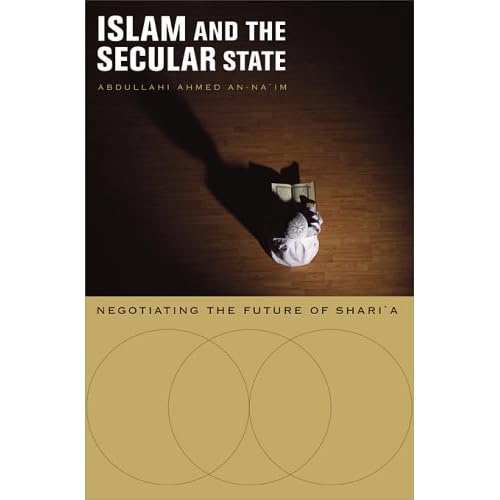
Getting back to An-Naim, his perspective takes it a conceptual step further. For Rizzo, he assumes only one moral framework within society, not multiple, competing ones. An-Naim posits the reality of a multiplicity of moral frameworks, all of which should be accommodated a priori, as a kind of humble and open minded predecessor to the project of transforming the middle east away from authoritarian regimes of all kinds. This accommodation would take the form of rejection of a centralized enforcement of just one variation on the overall Islamic narrative, and instead a secular enforcement of only those principles that broadly apply to all Muslims. Questions arise: What about non-Muslims? Is this simply Rawls redux? Read further on your own, though I’ll just say that Rawls, relative to An-Naim, relegated religion to the existential periphery.


 Dry Hyphen Olympics